A team of AI specialists
Powered by swarm intelligence, Future AI's specialized agents collaborate and decide together, weighing safety from the very first step of drug selection.
Future AI Robot is built on two platforms — AiPLEX and AiTOX — bringing efficacy and safety assessment together from the earliest stage of research, with candidates ready for rapid clinical entry and out-licensing.
01
Drug–disease matching
AiPLEX selection engine
Combines pharmacology, dosage-form assessment, and patent/clinical needs to precisely match drugs to indications across multiple disease areas.
Pharmacology · Dosage form · Patent/Clinical
02
Safety & toxicology prediction
AiTOX toxicology
Provides safety and ADMET assessment, aiming for animal-test-free toxicology prediction that screens out high-risk candidates early.
ADMET · DDI · Safety
03
Candidate optimization
Platforms in concert
AiPLEX and AiTOX work together to systematically screen and rank drug candidates, completing process development and in vitro / in vivo validation.
Candidates · Systematic · Ranking
04
Dementia lead application
Current focus
Has identified drug candidates that improve blood-brain-barrier penetration and promote neural repair, while advancing patent filing and toxicology-led preclinical validation.
BBB · Neural repair · Dementia
Two platforms
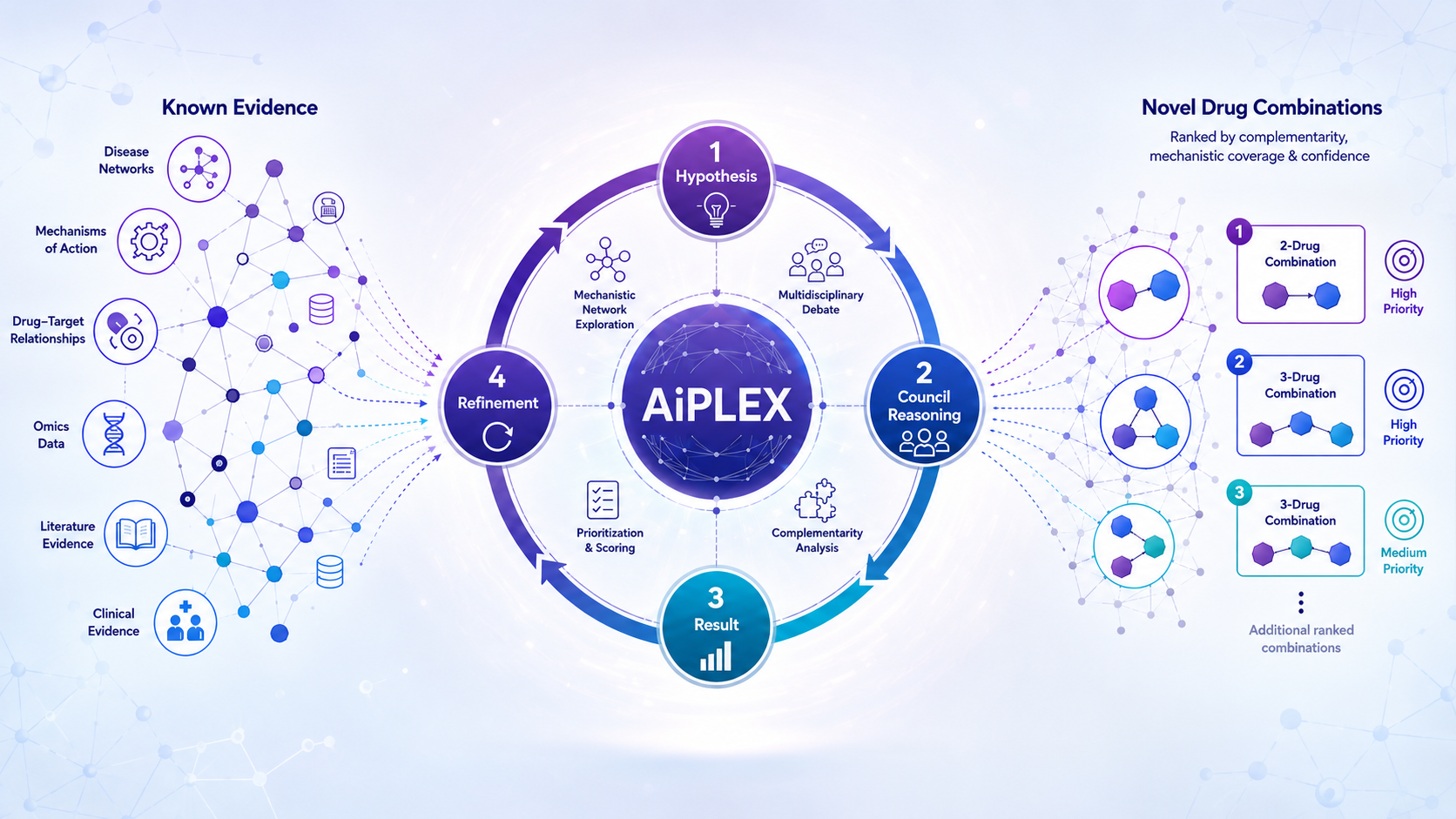
An explainable AI decision platform powered by domain-specialized models, multi-agent reasoning, and experimental feedback loops
Capabilities
Domain-specialized LLMs (CPT/SFT)
Continually pretrained and fine-tuned on biomedical corpora to understand disease mechanisms, therapeutic rationale, formulation feasibility, and real-world R&D context.
Multi-agent collaborative reasoning
Research hypotheses are evaluated by cross-disciplinary AI agents that divide tasks, challenge one another's conclusions, and integrate evidence into a unified assessment.
Hypothesis Council loop
A continuous cycle of “hypothesis generation → expert council review → evidence synthesis → hypothesis refinement” improves the depth, consistency, and reliability of each analysis.
Retrieval-augmented generation (RAG)
Retrieves scientific literature, databases, and internal knowledge to ground outputs in traceable evidence while reducing hallucinations and outdated conclusions.
AI-driven experimental design (AI-DoE)
Proposes high-information experiments based on candidate hypotheses and evidence gaps, with results fed back into the next decision cycle.
Benefits
From AI-generated hypotheses to a verifiable, iterative R&D loop
More reliable hypotheses
Cross-agent review and evidence-based challenge reduce the bias and blind spots of a single model.
More efficient experimentation
High-value experimental conditions are prioritized to narrow the candidate space with fewer trials.
A continuously improving system
Analysis and experimental results are fed back into the workflow, creating a continuous predict–validate–learn cycle.
Scope
AiPLEX supports early-stage evidence integration, hypothesis generation, and candidate prioritization. It complements—but does not replace—experimental, toxicology, clinical, CMC, or regulatory work.
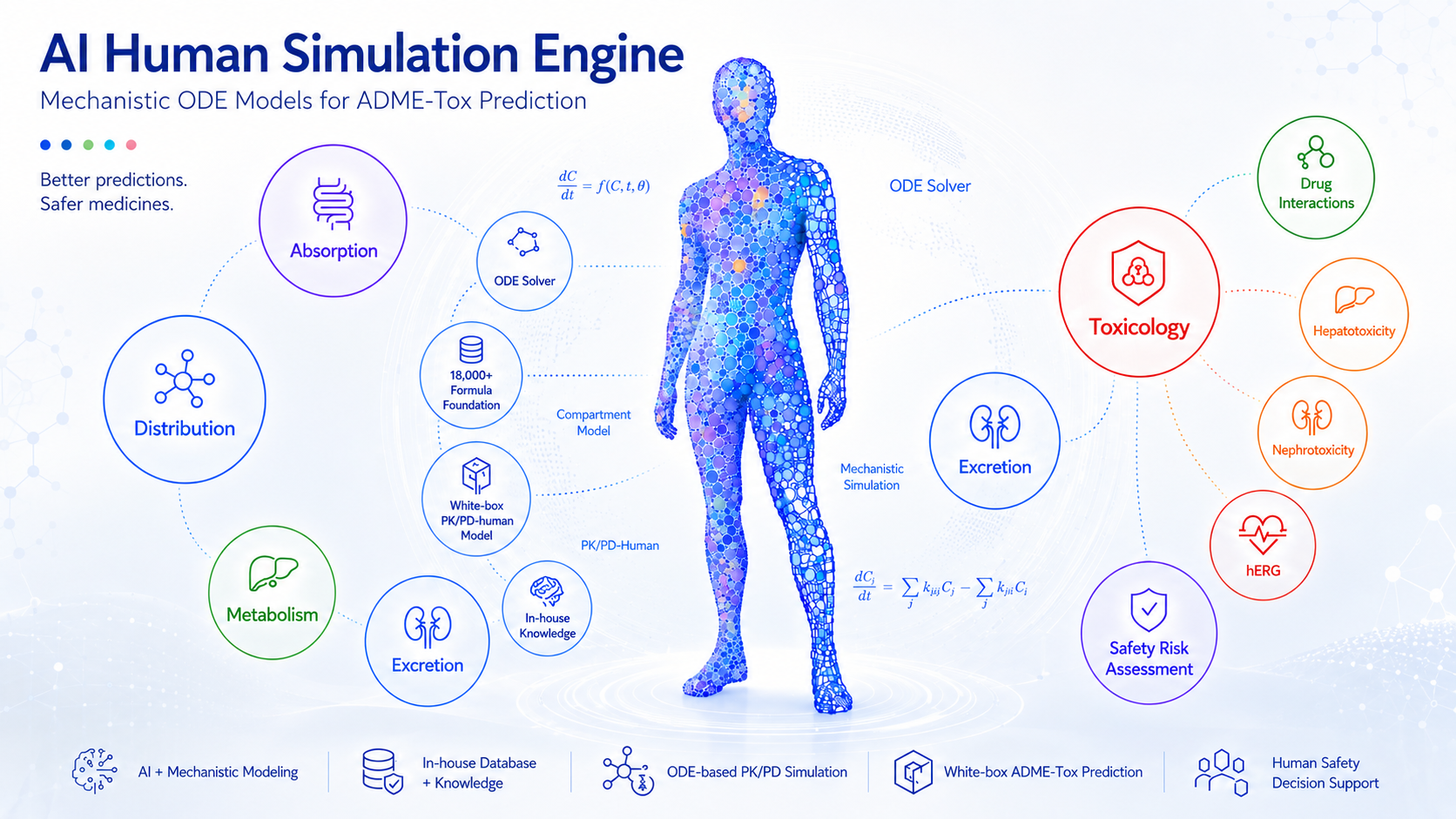
A toxicology-first, explainable platform for human safety prediction
Capabilities
Toxicology-specialized LLMs
Fine-tuned to apply the evidence interpretation, causal reasoning, and risk-assessment logic of toxicologists—not merely general pharmaceutical knowledge.
Toxicology-focused Graph-RAG
Integrates a toxicology knowledge graph with extensive scientific literature and regulatory data, enabling each risk assessment to be traced back to its supporting evidence.
Cross-scale toxicity modeling
Independent AI Cell, AI Mouse, and AI Human pipelines analyze cellular responses, animal exposure, and predicted human outcomes, integrating them into a unified safety assessment.
Proprietary PK/PBPK models
Simulate drug exposure, organ distribution, metabolism, and elimination to improve the translation of in vitro and animal data into predicted human responses.
AI-assisted experimental design (AI-DoE)
Designs validation experiments around candidate toxicity hypotheses and evidence gaps, with findings validated through wet-lab studies and fed back into the modeling workflow.
Benefits
Embedding toxicology into early candidate selection—for earlier risk detection, fewer unnecessary experiments, and greater human relevance
Earlier risk detection
Toxicology evidence is incorporated from the first screening step, helping identify organ toxicity, metabolic liabilities, and safety concerns before significant resources are committed.
Fewer unnecessary experiments
AI modeling narrows the validation scope and prioritizes critical experiments, reducing unnecessary reliance on extensive cell and animal testing.
Greater translational confidence
Cross-scale modeling combined with PK/PBPK simulation strengthens the connection between cellular, animal, and predicted human responses.
Scope
AiTOX predictions support decision-making and do not replace formal, regulatory-required toxicology studies.